Step 01
Connect
Securely sync your claims, remits, contracts, and charts. No workflow change.
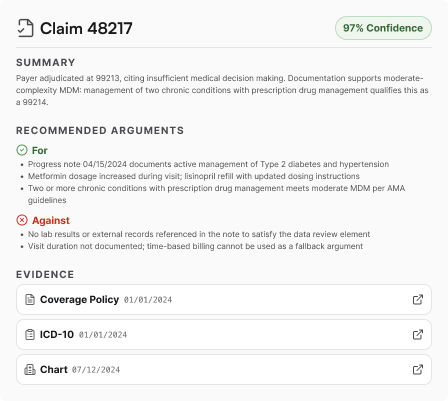
Revenue Recovery reviews every denied, rejected, and underpaid claim, then hands your team a cited, ready-to-resubmit recommendation. Your team reviews answers, not analysis.

Our AI agents do the reading, cross-referencing, and root-cause analysis your best biller does by hand across every claim in the queue, not just the largest few. Your team gets a clear, cited recommendation for each denial in one place.
The whole denial queue gets worked, so claims stop aging out untouched.
The exact correction, down to the service line, with the sources behind it.
Claims paid below your contracted rate are flagged automatically.
Your team reviews the answer and resubmits, not each case from scratch.
The investigation happens before a person ever opens the claim. Your team comes in at the end to review and resubmit.
Step 01
Securely sync your claims, remits, contracts, and charts. No workflow change.
Step 02
The agent reviews every denial against payer policies, LCD/NCD, and coding rules.
Step 03
It returns the fix at the service-line level, with every source cited.
Step 04
Your team reviews, applies the fix, and resubmits. The claim gets paid.
A denial is rarely fixed by reading one document. Each agent reads one part of the case the way a specialist would, then they reconcile what they find into a single, cited fix.
Clinical documentation supports a specific symptomatic arrhythmia rather than the unspecified code that was originally billed. The charted episodes strengthen the appeal and justify a more specific diagnosis.
Intermittent palpitations and transient dizziness over six weeks; denies syncope. Plan: ambulatory rhythm monitoring.
Two connected workspaces your team lives in. Claim Flow is where denials get resolved. True Pay is the library that makes every fix accurate.
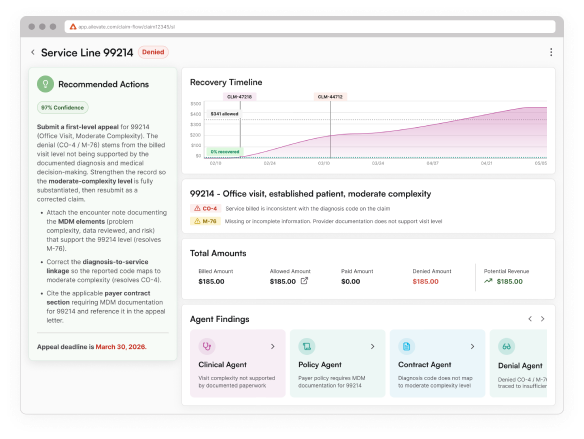
 Claim Flow
 Claim Flow gives you a single list of encounters, claims, and service lines, with views that switch to match how your team works. Open any claim for its recommended actions, or drill into a service line for the full agent analysis.
 True Pay
 True Pay is the library every recommendation is built on: your contracts, payer policies, fee schedules, standard charges, and modifiers, kept current in one place. It is what lets each agent cite an accurate, defensible fix.
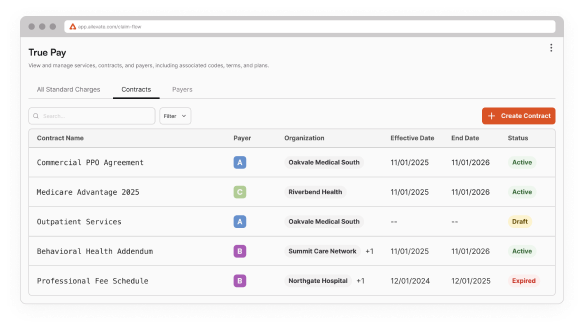

Investigated and corrected at the service-line level, with cited fixes your team can trust.

Payments below your contracted rate, flagged automatically. Revenue you would have missed.

Root-cause patterns surfaced so your team can fix them upstream and stop the repeat.
Edit any number below to see the recovery update live. We build the real model with you in the pilot.
Illustrative estimate based on the figures you enter. Actual recovery depends on your payer mix, contracts, and denial patterns.
Every day a denial sits unworked is a day you wait on money your team has already earned. Revenue Recovery turns that wait into a fix.